
Europe's Growing Wildfire Challenge: What Can the UK Learn About Emergency Preparedness?

Wildfires Are Becoming a European Challenge
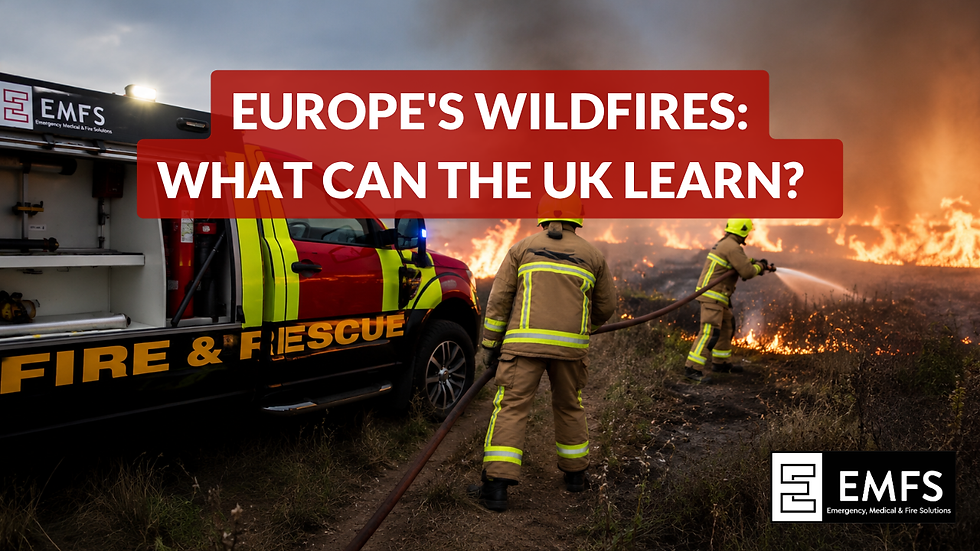
Over recent weeks, Europe has witnessed a series of significant wildfires affecting multiple countries, reminding us just how quickly these incidents can escalate and the devastating consequences they can have for communities, infrastructure and emergency services.
In south-west France, firefighters have been tackling one of the country's most significant wildfires in recent years as flames spread through woodland near Bordeaux, prompting large-scale evacuations and requiring an extensive emergency response.
Across Spain, firefighters have also continued to battle major wildfires following an exceptionally challenging season, while other parts of southern Europe remain on heightened alert during periods of extreme heat.
Our thoughts are with everyone affected by these incidents, including those who have lost loved ones, those forced to leave their homes and businesses, and the firefighters and emergency responders working around the clock in extremely demanding conditions.
Whilst each incident is unique, together they raise an increasingly important question:
Is Europe adapting quickly enough to the growing challenge of wildfires?
Wildfires Are No Longer Just a Mediterranean Problem
For many years, countries such as Spain, Portugal, Greece and Italy have developed specialist wildfire capabilities due to the frequency of large vegetation fires.
However, recent events show that wildfire risk is becoming a wider European issue.
Longer periods of dry weather, increased fuel loads, changing weather patterns and stronger winds are creating conditions that allow fires to spread rapidly across large areas.
These incidents are placing significant pressure on emergency services, transport networks, utilities, businesses and local communities.
For emergency planners, wildfire resilience is becoming an increasingly important part of broader risk management.

What Does This Mean for the UK?
Although the UK experiences a different climate to much of southern Europe, recent years have demonstrated that large-scale wildfires are no longer uncommon.
Several major incidents have highlighted the risks posed by prolonged dry weather.
Saddleworth Moor (2018)
One of Britain's largest moorland fires burned for several weeks across the Peak District, requiring support from multiple Fire and Rescue Services and military assistance.
Wareham Forest (2020)
A significant woodland and heathland fire in Dorset demonstrated how quickly dry vegetation can fuel rapidly spreading fires.
Wennington, East London (2022)
During the UK's record-breaking heatwave, multiple grass fires broke out across London.
The fire in Wennington destroyed homes, overwhelmed local resources and resulted in one of London's busiest operational days since the Second World War.
These incidents demonstrate that wildfire preparedness is no longer simply an issue for Mediterranean countries.
It is becoming increasingly relevant to emergency services, businesses, infrastructure operators and local authorities across the UK.
Why Wildfires Spread So Quickly
Every wildfire requires three essential ingredients:
Heat
Oxygen
Fuel
When vegetation becomes dry following prolonged periods of warm weather, it creates an abundant fuel source.
Add strong or unpredictable winds, difficult terrain and low humidity, and a relatively small ignition source can develop into a fast-moving wildfire within minutes.
For firefighters, this creates constantly changing operational conditions where situational awareness and rapid decision-making are critical.
Technology Is Changing the Way We Fight Wildfires

As wildfire incidents become more complex, emergency services around the world are embracing new technologies that improve both prevention and operational response.
Artificial Intelligence
AI-powered camera systems can continuously monitor forests and open countryside, identifying smoke within minutes of ignition.
By detecting fires earlier, emergency services can often respond before a small incident becomes a major wildfire.
Drone Technology
Drones equipped with thermal imaging cameras have become invaluable during wildfire incidents.
They provide incident commanders with live aerial intelligence, helping crews to:
locate hidden hotspots;
monitor fire spread;
assess dangerous terrain;
protect firefighter safety;
support tactical decision-making.
Satellite Monitoring
Modern satellite technology enables emergency planners to monitor heat signatures across huge geographical areas.
Satellite imagery helps authorities detect new fires, monitor active incidents and coordinate resources more effectively.
Predictive Fire Behaviour Modelling
Advanced software is now capable of combining weather forecasts, wind direction, terrain information and vegetation data to estimate how a wildfire is likely to develop.
These predictive models help emergency responders:
position resources more effectively;
support evacuation planning;
identify critical infrastructure at risk;
improve operational decision-making.
Rather than simply reacting to fires, many agencies are now using technology to anticipate how incidents may evolve.

Prevention Remains Our Strongest Defence
Despite advances in technology, prevention continues to be one of the most effective ways of reducing wildfire risk.
Many vegetation fires begin through human activity, meaning simple actions can make a significant difference.
If you're spending time outdoors this summer:
🔥 Never leave disposable BBQs or hot ashes behind.
🚭 Dispose of cigarette ends safely.
🚗 Avoid parking vehicles on long, dry grass where hot exhaust systems may ignite vegetation.
🗑️ Take all litter home and help protect natural environments.
🚫 Respect local fire restrictions and warning signs.
📞 If you discover signs of a wildfire, move to a place of safety and report it immediately.
Small actions today can prevent devastating consequences tomorrow.
Looking Ahead
Wildfires are becoming more frequent, more complex and increasingly resource-intensive across Europe.
Whilst the UK may not face the same scale of incidents experienced by some Mediterranean countries, recent events have demonstrated that no nation is immune to the risks created by prolonged dry weather and extreme temperatures.
For emergency services, businesses, infrastructure operators and public organisations, resilience is no longer just about responding to incidents.
It is about preparing for them.
Investment in technology, training, public awareness, prevention and collaborative planning will all play an increasingly important role in reducing future wildfire risk.
At EMFS Group, we work alongside organisations operating across fire safety, emergency response and critical infrastructure. As risks continue to evolve, sharing knowledge and encouraging discussion will remain essential to improving resilience.
Join the Discussion
Wildfires are no longer simply a seasonal issue affecting southern Europe-they are becoming an increasingly important consideration for emergency planners across the continent.
Do you believe the UK is investing enough in wildfire preparedness?
What lessons can we learn from the approaches being adopted across Europe?
We'd welcome the views of firefighters, emergency planners, facilities managers, local authorities and anyone working within the emergency services sector.


Comments