
Martyn's Law: What Event Organisers and Venues Need to Do Now


The Terrorism (Protection of Premises) Act 2025, better known as Martyn's Law, received Royal Assent in April 2025. There's no legal requirement to comply until the Act comes into force, expected around spring 2027 once the 24-month implementation period ends. But treating that date as the start line is a mistake. Safety Advisory Groups are already asking organisers what they're doing about it, insurers are starting to factor it into risk conversations, and the venues and events that leave preparation until the enforcement clock actually starts will be doing it under pressure. This isn't a distant compliance deadline. It's a live planning question for anyone running a public event or venue in the UK right now.
This piece sets out what Martyn's Law actually asks of you, and what to do about it this season rather than in 2027.
What Martyn's Law Actually Requires
Martyn's Law applies based on how many people may reasonably be expected to be present at your premises or event at the same time, counting staff as well as attendees, assessed at peak.
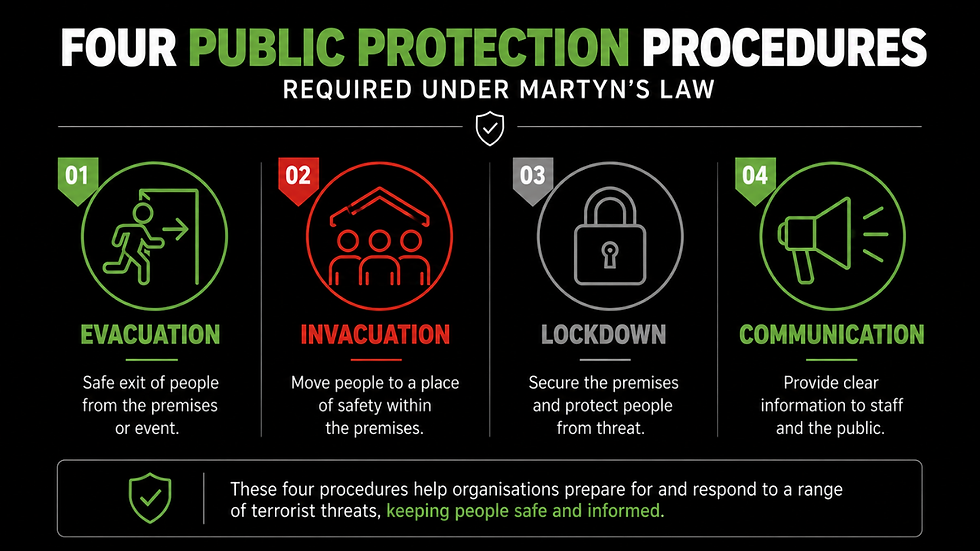
Standard duty covers premises and events expecting 200 to 799 people at once. It requires public protection procedures across four areas: evacuation, invacuation (moving people to safety within the venue rather than out of it), lockdown, and communication.
Enhanced duty applies at 800 or more. It carries everything in standard duty plus additional public protection measures, a designated senior individual with personal accountability for compliance, and a compliance document that has to be produced to the Security Industry Authority, which regulates the Act. Penalties for enhanced duty breaches run into the millions, so this isn't a box ticking exercise for larger events.
If your numbers hover around the 200 or 800 mark across different events in a season, it's worth assessing tier by tier rather than assuming one answer covers every date on the calendar. A one-off higher attendance date, a festival extension, or an additional stage can be enough to shift a normally standard duty event into enhanced duty territory for that single occasion.
The financial exposure is worth understanding too. Standard duty breaches carry lower fixed penalties, but enhanced duty breaches can run to several million pounds or a percentage of worldwide revenue, whichever is greater. For larger organisers and venue operators, this is a board level risk, not just an operational one.

What to Actually Do About It Now
Most of what's published on Martyn's Law is legal explainer content: what the Act says, who it applies to, when it comes into force. Useful for background, but it doesn't answer the question most organisers are actually sitting with, which is what to physically do between now and enforcement. A few practical steps:
Work out your tier properly. Count everyone likely to be on site at your busiest point, including staff, contractors and crew, not just ticketed attendance. Occasional higher capacity events can pull an otherwise standard tier venue into enhanced duty for that date.
Map what you already have against the four standard duty areas: evacuation, invacuation, lockdown and communication. Most venues and organisers already hold evacuation plans and fire procedures, built up over years of fire risk assessments and licensing conditions. The gap is usually invacuation, lockdown and communication planning specific to a hostile threat rather than a fire. Moving people to safety inside the venue, securing an area against an ongoing threat, and getting clear instructions to staff and the public in the moment are different problems to solve than getting everyone out of a building, so this is the part worth reviewing first rather than starting from a blank page.
If you're in enhanced duty territory, start building the compliance document now. Appointing a designated senior individual and documenting your public protection measures takes time to do properly, and it isn't something to assemble in the weeks before an event.
Don't wait for a Home Office deadline to move. SAG panels are already raising Martyn's Law in pre-event meetings for larger festivals and venues. Being able to answer those questions now, ahead of formal enforcement, is what actually protects your event's licence and reputation.
Where This Overlaps With What EMFS Already Does
If EMFS already provides your event medical and fire cover, a meaningful part of Martyn's Law preparation isn't a separate project bolted on top. Our risk assessments, medical needs assessments and fire safety planning already map crowd flow, egress routes and incident response for your event. That's the same groundwork that underpins invacuation, lockdown and communication planning under the Act.
Running fire and medical cover through one CQC-registered, BAFE-certified provider also means one risk assessment and one incident command structure instead of two separate providers each documenting to their own standard. When a SAG or the SIA asks how your event responds to an incident, having a single, coherent answer is a stronger position than piecing one together from multiple suppliers after the fact.
Talk to EMFS about where your event or venue sits under Martyn's Law and what practical steps make sense for your season. Book a discovery call and we'll walk through your capacity, your current plans, and where the gaps actually are.
Getting Ahead of the Deadline, Not Behind It
Spring 2027 feels distant until you consider how long it actually takes to build a proper compliance document, train staff on invacuation and lockdown procedures, and get a designated senior individual genuinely across the detail rather than just named on paper. For anyone running recurring events or managing a venue with a full calendar, this is groundwork best started now, while there's still time to do it properly rather than in a rush once enforcement is confirmed.
If you're planning next season's events or reviewing venue safety arrangements, get in touch with EMFS to talk through your Martyn's Law position alongside your existing medical and fire cover.
One conversation, one plan, one provider who already knows your event.


Comments